


- Reproduction
- Numero oggettoCOMWG.155
- Creatore
- Titolo
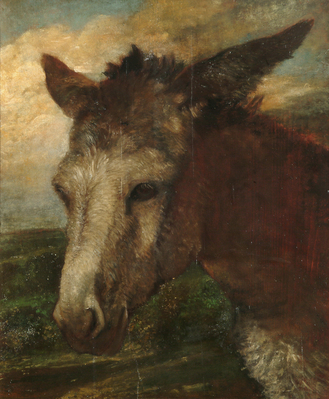
Head of an Ass
- Datanot before 1862 - not after 1863
- Materiale
- Dimensioni
- Painting height: 61 cm
Painting width: 51 cm - Descrizione
This lovingly rendered head of an ass was done in preparation for the painting of Una and the Red Cross Knight (1869, Art Gallery of Western Australia), a photograph of which from 1869 by Frederic Hollyer is in the Watts Gallery Collection COMWG2007.802. In the painting which illustrates Spenser’s (1552/1553- 1599) epic poem The Faerie Queene (1590), Una can be seen riding on a donkey next to the Red Cross Knight as she does in Book 1 of Spenser’s poem. ‘A lovely Ladie rode him faire beside,/Upon a lowly Asse more white then snow,/Yet she much whiter, but the same did hide/Under a vele, that wimpled was full low,/And over all a black stole she did throw,/As one that inly mournd’ (Bk 1, 28-33). Whereas the Head of an Ass more closely resembles Spenser’s white asse, the animal’s coat appears to be painted in a somewhat darker grey colour in the finished painting.
The composition is reminiscent of a tempera painting by William Blake The Characters in Spenser’s Faerie Queene where Una and the Red Cross Knight can be seen riding together, which is now at Petworth House, West Sussex [1].
The model for Una was the novelist Virginia Woolf’s aunt Mary Louisa Fisher, née Jackson, who was the sister of Julia Prinsep Stephen (1846-1895) and the Red Cross Knight was modelled after Arthur Prinsep (COMWG2007.802, 1869). Mary Louisa Fisher (1841-1916), like her sister Julia Leslie Stephen, also modelled for Watts’s friend and protégé the photographer Julia Margaret Cameron. Virginia Woolf once referred to the painting of Mary Louisa as Una as ‘Aunt Mary on a donkey.’ [2]. In 1880, Watts painted the historian Herbert William Fisher and Mary Fisher’s daughter Miss Florence Fisher (COMWG2007.768, 1880). Their daughter went on to become a playwright and married Frederic William Maitland. Her second marriage was to the botanist Sir Francis Darwin, son of Charles Darwin, in 1913 when she became known as Florence Henrietta Darwin, Lady Darwin.
The finished painting of Una and the Red Cross Knight (COMWG2007.802, 1869) which shows Una riding on the donkey, for which this study was made, was noted alongside Jacob and Esau (COMWG.25, 1878) as one of two paintings that best exemplified Watts’s strong ‘faculty of colour invention’ at the Burlington House exhibition of 1905 [3]. The effect of these two paintings depended on ‘the daring pictorial invention of a sky that is virtually white’ and they were seen as important examples of ‘his consistent creativeness as a colourist, as a designer, and as a technician’ [4].
The donkey is symbolic of Una’s ties to Christ, who entered Jerusalem on the back of a donkey, and underpins her status as an icon of moral purity, whose family’s kingdom has been lost. Watts’s painting depicts the very beginning of the first book of Spenser’s epic, as Spenser tells us that Una has convinced the Knight to avenge her family. The overcast sky was not only an effective colour, but also true to Spenser’s narrative which begins as the pair ride together and ‘Thus as they past,/The day with cloudes was suddeine overcast,/And angry Jove an hideous storme of raine/ Did poure’ forcing the couple to take shelter in a nearby ‘shadie grove’ seen in the background of Watts’s composition (Bk 1 49-52) [5].
Watts’s Head of an Ass, on the other hand, shows a rather happy looking donkey in a landscape of green undulating hills and blue skies.
Furthermore, this is not the only painting by Watts to feature the head of an ass. Apart form his pictures of Una and the Knight, Watts included donkeys in two of his paintings of The Good Samaritan too. He also made several delicate studies of donkeys from nature which are now in the Watts Gallery Collection [6].
Footnotes:
[1] John E. Grant and Robert E. Brown, ‘Blake’s Vision of Spenser’s Faerie Queene: A Report and Anatomy’ in Blake An Illustrated Quarterly 8.3 (1974-75), pp. 56-85.
[2] Virginia Woolf, The Diary of Virginia Woolf, Vol. 2 (1920-1924) ed. Anne Olivier Bell, page 113.
[3] There is another study for the painting in which Una rides on a white horse. The study was exhibited at the Grosvenor Gallery in 1879 with the incorrect title Enid and Geraint. See Anon. ‘The Grosvenor Gallery Exhibition’ in The Athenaeum 2689 (May 10, 1879), pp. 606-608. However, another perceptive reviewer noted that Enid and Geraint ‘look very much like the Red Cross Knight and Una’. See Anon. ‘The Grosvenor Gallery – Our Annotated Catalogue’ in the British Architect (May 23, 1879), pp. 211-212. Incidentally, Princess Louise had exhibited a sculpture, Geraint and Enid, at the Grosvenor Gallery the year before. A third version is in the collection of St Hilda’s College, University of Oxford. It is the version which was given to Mary Louisa Fisher and her husband. Mary Louisa had sat for Watts shortly before her marriage in August 1862.
[4] Anon. ‘G. F. Watts at Burlington House’, in The Athenaeum 4031 (Jan 28, 1905), pp. 119-120, p. 119.
[5] However, the shadie grove turns out to be the nightmarish Wood of Error.
[6] See Watts’s drawings of donkeys Pencil Study of a Donkey Family in a Field (COMWG2007.602b) Rural Scene (COMWG2007.3), Rural Scene (COMWG2007.4), Rural Scene COMWG2007.6).
Text by Dr Eva-Charlotta Mebius
|
|
