


- Reproduction
- Номер объектаCOMWG.129
- Создатель
- Название
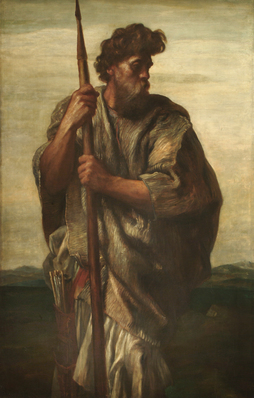
Esau
- Датаnot before 1860 - not after 1865
- Материал
- Размерность
- Painting height: 144.8 cm
Painting width: 127 cm
Frame height: 188 cm
Frame width: 138 cm - Описание
Jacob and Esau were twin brothers whose story is told in the Book of Genesis. Esau, the first-born, was a hunter and a man of the fields, while Jacob led a settled life in an encampment. Jacob gained Esau’s birthright by guile and deprived him of his father’s blessing. However, Esau forgave Jacob. Watts probably intended this painting as part of his never realised ‘House of Life’ scheme of public frescoes. These frescoes were intended to show the creation of the world and evolution of mankind primarily through Old Testament stories.
Watts’s illustration of the story of Jacob and Esau (COMWG.25, 1878), the twin sons of Isaac and Rebekah, from Genesis suggested a certain admiration for Esau, who forgave his brother Jacob who tricked him into giving up his birthright for a bowl of lentil stew [1]. This is supported by the fact that Watts also chose to depict Esau ‘the cunning hunter, a man of the field’ on his own. [2]. We see him here in this three-quarter-length portrait of the forgiving brother, who cuts a rather noble, heroic figure as he rises out of the prehistoric landscape that extends behind him. Esau appears as he is first described in Genesis ‘red, all over like an hairy garment’ (Genesis 25:25).
In fact, Watts’s biblical pictures exhibit a remarkable attention to the landscape of its figures. As J. E. Phythian noted, the pictures were made ‘more impressive by the figures being placed in a bare upland country where the eye ranges over a wide prospect of hills, billowy as if a sea had been changed into solid ground’ [3]. We find several biblical figures framed by such a motionless sea, for example in Samson (COMWG.75, 1871) Jacob and Esau (COMWG.25, 1878), The Good Samaritan (COMWG.140, 1849-1904), and The Prodigal Son (COMWG.192, 1872-1873). For Phythian, such ‘vastness of the surroundings helps to give that sense of far-off time and place which fits them’ [4]. Roger E. Fry was among those who also drew attention to the ‘surprising originality’ of Watts’s work in landscape [5].
The landscape of Esau shares the same ‘virtually white’ sky as that of The Good Samaritan (COMWG.140, 1849-1904) and Jacob and Esau (COMWG.25, 1878-1879) [6]. Critics likened Watts’s ‘richer and more fluent method’ in these works to that of Joshua Reynolds and Thomas Gainsborough [7]. In particular, it was suggested that Watts’s contemporary, the sculptor and painter Alfred Stevens, had ‘pointed the way to more complete fusion’ between Watts’s master Michelangelo and the more fluid lines of the Venetians, such as Titian [8].
Footnotes:
[1] See J. E. Phythian, George Frederick Watts (London: Grant Richards Ltd, 1911), pp. 108-109.
[2] J. E. Phythian, p. 137.
[3] Ibid., p. 137.
[4] Roger E. Fry, ‘Watts and Whistler’ in The Quarterly Review April 1905, pp. 607-623, p. 621.
[5] Anon. ‘G. F. Watts at Burlington House’ in The Athenaeum Jan 28, 1905, pp. 119-120.
[6] Ibid., p. 119.
[7] Ibid., p. 119.
Text by Dr Eva-Charlotta Mebius
|
|
