


- Reproduction
- Número del objetoCOMWG2007.904
- Creador
- Título
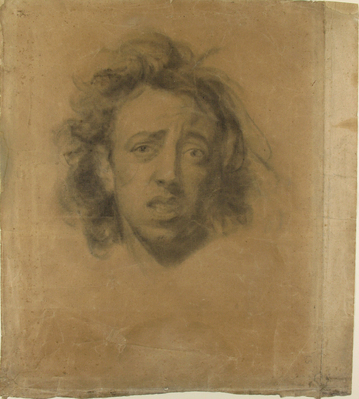
Charcoal Self-Portrait Study known as 'Fear' (c. 1835-6)
- Fechacirca not before 1835 - circa not after 1836
- Medium
- Dimensiones
- drawing height: 50.6 cm
drawing width: 45 cm
mount height: 61 cm
mount width: 50.8 cm
frame height: 68.9 cm
frame width: 58.5 cm - Descripción
This self-portrait, completed when Watts was eighteen or nineteen years old, is the ultimate expression of youthful angst. Depicting himself in a state of fear, Watts drew on the years he spent studying facial expression and emotion in the earliest stages of his career. With wild eyes and equally wild hair, the self-portrait epitomises the intensity of emotion that took centre stage in the art and literature of the Romantic period, and pre-dates Courbet's own similar self-portrait, "The Desperate Man," by at least six years. Text by Chloe Ward
In Volume 1 of George Frederic Watts The Annals of an Artist’s Life Mary Watts recorded G F Watts’s thoughts on self-portraits when writing to collector Charles Rickards. When writing about artists’ creation and displaying self-portraits G.F. Watts stated:
You have twice expressed a wish that the portrait that you have of me should be exhibited; this I should be most unwilling to have carried out, and hope you do not greatly set your heart upon it, for it would be really disagreeable to me; not that I see any reason against an artist painting himself, but the contrary. The most interesting gallery I know is the collection of artists' portraits, painted by their own hands, and I paint myself constantly; that is to say, whenever I want to make an experiment in method or colour, and am not in a humour to make a design. So there are other portraits of me, and if I live there may be many more, but I should not like to display them to the public. I should feel a sort of absurdity attaching to such a proceeding." [1].
Within this passage Watts captured not only his thoughts about self-portraits, but his motivation in creating so many of them over his career. He highlights how these self-portraits are experimentations for him to try new methods or colours. This self-portrait, created with black chalk on paper when the artist was approximately eighteen or nineteen years old seems to fit within idea of creating self-portraits as experiments. Differing from other self-portraits in which he presents himself in costumes or within specific poses this work sees Watts using different media in order to express an emotion.
Watts scholars builds provides another analysis of this work and places it within a context of works by Watts and others. Chloe Ward notes that this self-portrait is very different from another completed only two years prior (COMWG.10) and both she and Nicholas Tromans compare it to Pencil Study of a Man’s Frowned Face (COMWG2007.895) which Watts completed in 1827 [2]. Ward notes that this work shows how much Watts’s skills progressed since this 1827 drawing as this work completed using shading and composing shadows [3]. Furthermore, Ward speculates that this work summarizes the Watt’s life at this time as during this period he grew frustrated studying at the Royal Academy while also capturing the spirit of the late Romantic period in the 1830s [4]. Consequently, far more than an experiment Ward sees this work as an artist furthering his skills and moving into a new career period.
Gould, Underwood, and Jeffries also address how this work marks a stylistic change by Watts. Like Ward, they also point out how this work differs from the self-portrait he completed just two years prior as in this work he “roughed up his straggly hair” [5]. Additionally, they note that Watts likely used a looking glass in order to capture image, but differ from Ward about the inspiration for this work as they compare his expression to Caravaggio’s Medusa (c. 1598) especially the open mouth and the brow [6]. Therefore, like Ward and Watts and himself, they note how this work marks experimentation and a new period in his work.
Footnotes:
[1] Mary Watts, George Frederic Watts The Annals of an Artist’s Life, page 245.
[2] Chloe Ward, The Drawings of G.F. Watts, page 30; Nicholas Tromans, The Art of G.F. Watts, pages 21-22.
[3] Chloe Ward, The Drawings of G.F. Watts, page 30.
[4] Chloe Ward, The Drawings of G.F. Watts, page 30.
[5] Veronica Franklin Gould, Hilary Underwood, and Richard Jeffries, “37. Fear c. 1835-1836,” The Vision of G F Watts, page 59.
[6] Veronica Franklin Gould, Hilary Underwood, and Richard Jeffries, “37. Fear c. 1835-1836,” The Vision of G F Watts, page 59.
Text by Dr Ryan Nutting
|
|
